Friday, March 18, 2016

March Update


In the past two months our first grade social detectives continued to learn about expected behaviors in our Conversation and Greeting Skills Unit.  We have learned about a lot of new tools to help use those expected behaviors. When learning about personal space, our social detectives practiced using rulers to determine the amount of personal they needed to feel comfortable. Personal space is an expected behavior that leads to us and our friends having comfortable thoughts and feelings. We learned that everyone needs different amounts of personal space and that this need can also change based on who is surrounding us. It is important to use our social detective skills to know how much personal space a person needs. 
Social Detectives observing that Ms. Casavant needs more personal space than Mrs. Terrio

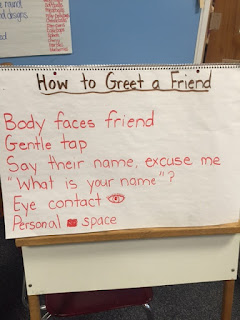
We learned the importance of making sure we face the person we are talking with and using eye contact to show that we are interested in what they have to say. When having a conversation it is expected to use a medium volume and friendly tone. Our Social Detectives explored how to stay on topic or change the topic of conversation. To stay on topic we talk about the same thing. For example if Ms. Casavant is talking about her favorite football team with Mrs. Terrio, then Mrs. Terrio should talk about a favorite football team as well. Everyone learned that we need to: listen to the person talking, Answer/ Respond to them and then Wait for a pause or break before changing to a new topic. We enjoyed practicing these skills each week through social-role plays. Social Detectives would practice the expected way to greet and have a conversation.


Mrs. Conway's Class thinks good listeners....
Then our Social Detectives brainstormed a list of what good listeners looked and felt like. After we read the book “My Mouth is a Volcano” by Julia Cook and then discussed how to be a good listener by using our whole body listening and not interrupting others when they talk. In this story a boy named Louis always interrupted. He learned the hard way when his friend interrupted his special presentation that interrupting is unexpected and leads to uncomfortable thoughts and feelings. His mom taught him to use the strategy of taking a deep breath whenever he felt he might interrupt. The Social Detectives completed a training assignment that required them to be on the lookout for strategies they could use when they though their volcanoes might erupt (interrupt) like Louis'. Ask your child what strategy they like to use!


During the months of March and April our focus will be game playing skills. Our fellow Social Detectives will learn strategies to decide who goes first or who gets to choose using the Who Goes First Wheel.  We will discuss how to invite a friend to play using all of our previously learned conversation skills.  Using the Model Me Kids Videos for Teaching Social Skills by Example we will learn what to do when you ask a friend to play and they say no. This will also include when it is okay to say no to a friend, such as when it is a DOUBLE D (dangerous or destructive) or a promise was made to play with someone else. Other skills included in this unit will be how to establish and renegotiate the rules of a game/activity, joining an existing game and what to do when you feel left out. Our Social Detectives will continue to watch the adults model these skills and will have the opportunity to role-play these skills together.


Now that the weather is getting warmer we will be able to spend more time outside practicing all the skills we have learned. During these two months we will focus on teaching our Social Detectives how to play Solution Wheel Tag. If you would like to learn how to play this at home check out the parent resource tab for the instructions. You will also see an update to the books and great article on guidelines for playdates.


Thank you for visiting our blog! Feel free to comment about what our Social Detectives have been busy learning about. 

-Mrs. Bonenfant, Ms. Casavant and Mrs. Terrio


Monday, January 25, 2016

January Update


 We hope you are enjoying the Recess Club blog and finding the information useful and the parent resources helpful within your home and out in the community.  Our Social Detectives just finished our self-regulation and friendship skills unit.


 In this unit we learned how to think with our eyes and make a smart guess. Michelle Garcia Winner from her book, Thinking about YOU, Thinking about ME, (2007) defines “smart guesses” (same as educated guess) as guesses you have to make based on a fact or some information you have learned about a topic and now you just have to add one more guess. An example of thinking would be noticing that your friend has on a t-shirt that says “Star Wars.” As smart guess would be that they like Star Wars so it would be a smart guess to ask them if they saw the new movie.


During recess club we also play the Thinking with our eyes game. To play this game, we sit in a circle on the floor and the leader has a ball in their hand. Only using their eyes, the leader looks at another person in the circle and rolls the ball to that person. That person then uses their eyes to pick the next player. This continues until everyone has had a chance to catch and roll the ball.


We finished the unit with learning how to appreciate our differences. Student's learned that every friend has differences. These differences may include their height, hair color or age. Everyone has strengths and weaknesses. Our students composed a list of what they find easy and hard for them at Robinson School. We learned that just because something may be easy for us and hard for our friend does not mean we can't be friends.  To handle these differences we may be an ICARE friend by offering to help our friend with things that are hard for them. It is always important to ask first if you can help! Our students then signed a pledge to promise to work on making their social smarts stronger by working on being a better friend using all the skills we learned this unit.


During the months of January and February, we will be shifting our focus to greeting and conversation skills. Students will learn the expected way to gain one’s attention and greet a friend. This will include lessons on eye contact, the importance of personal space, and an exploration into the volume and tone of our voices.  Our fellow social detectives will practice how to listen and answer by reciprocal turn-taking when having a conversation. This includes learning to stay on topic and how to wait for a pause in the conversation to change the topic. 


Students will practice these skills through watching videos such as, Model Me Kids, through social role-plays and books. We will discover the importance of how to manage their thoughts and words without interrupting by reading the story My Mouth is a Volcano , by Julia Cook. We will also learn how our word choice can impact our friendships with the story Sticks and Stones by Carol Cummings. More information on these books and other stories you may read at home can be found under the parent resource page.


-Mrs. Bonenfant, Ms. Casavant & Mrs. Terrio

Thursday, December 10, 2015

Welcome to the Robinson Recess Club Blog!

We are so excited to share with you more information about what Recess Club is, resources you can use at home and frequent updates on what it is we are teaching our First grade students. You can find more information about who we are, what Recess Club entails, our curriculum and resources under pages.

Our First grade students have been very busy learning to be Social Detectives and how to be a good a friend. A Social Detective uses their eyes, ears, brains and bodies to figure out what we expect friends to do and say, as well as what is likely to happen next. Children were asked to notice these expected (friendly) behaviors and to practice using these expected behaviors throughout their school days, at home and within the community.

Student's also learned about unexpected (unfriendly) behaviors and how to use their whole body to listen. We explored what whole body listening looks like and how this  in combination with expected behavior leads our friends to have comfortable thoughts, which helps us make and keep our friends. We also learned how unexpected behaviors can make it difficult to make and keep friends because they give our friends uncomfortable thoughts and feelings.
Children are learning specifically how to use their bodies in developing and maintaining friendships through self-regulation. Using the Zones of Regulation by Leah Kuypers. Many of our First Grade students were introduced to this curriculum during Kindergarten. In Recess Club, they are learning to identify the various feelings our bodies feel throughout the course of the day and how to label each feeling according to a zone. We've discussed how we strive to maintain control of our bodies and behaviors and how the green zone is optimal for learning and being just right. This promotes comfortable thoughts and feelings.

The  Zones of Regulation includes 4 zones:
  1. Green: when our body/engine is running just right and we are ready to work or play.
     2.  Blue: when our body/engine is running low, our body has low energy and we may feel tired or 
                   sick.

     3.  Yellow: when our body/engine is running a bit higher, our body has some extra energy and we 
                        may lose some control.

     4.  Red: when our engine is running high/fast and we have a lot of extra energy in our bodies. We    
                   are likely to lose control.

After introducing the Zones, we then explored tool/strategies they may use to assist them when their bodies are in a zone. Students enjoyed identifying each zone and modeling what tool they could use within that zone to help them return to the green zone.

We will conclude this unit throughout December and through beginning of January by discussing differences, making smart guesses and thinking with our eyes. Using the video: Everybody's Different we will discuss and explore how we all have strengths and areas of difficulty. Students will learn that having areas of difficulty is okay and each of us can all try our best when anything is hard for us. In addition, we will discuss caring ways to be helpful to our friends when something is difficult for him or her.

~Jennifer Bonenfant SST; Kristina Casavant SST and Mary Terrio School Counselor~